Read the theory
Read FP_THEORY.md for the definitions and proof scope. Historical drafts explain how the theory changed; the canonical specification is the reference.
Read moreFP studies typed causal positive programs built from a small native algebra. The project separates theory, implementation and experiment results. Start with the canonical theory, then inspect the evidence for the question you want to work on.
Read FP_THEORY.md for the definitions and proof scope. Historical drafts explain how the theory changed; the canonical specification is the reference.
Read moreThe claims register distinguishes proofs, numerical checks, measured results and open questions. Follow the linked evidence before interpreting a claim.
Read moreChoose a registered protocol and pin its source version. Keep the environment, resource costs, limitations and negative findings with the result.
Read moreThe registered experiment compares 54 configurations on two known tables. Its report includes measured resource tradeoffs and a precision plateau. Read the protocol and limits alongside the plot.
Read the experiment and limits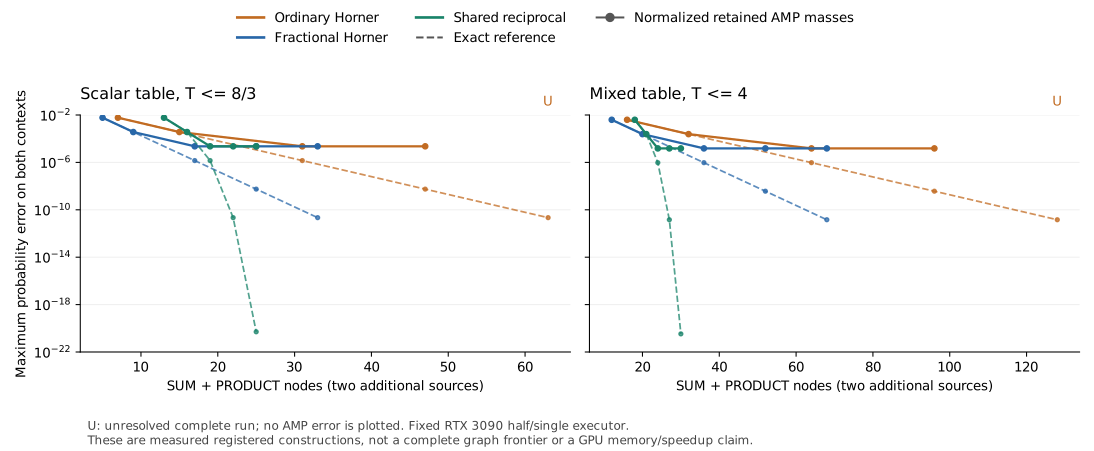
Read the sources that match the work you want to do, then ask a focused question or choose a task on HeartBoat.
Read the canonical theory and claims register. Identify the precise claim you are investigating before proposing a proof, counterexample or experiment.
Read moreA reproduction uses its own registered protocol and resource requirements. Check hardware, time, precision and retained evidence before running it.
Read moreReport the source revision, actual steps and limitations. Useful negative findings should stay with the evidence rather than be replaced by a more favorable result.
Read moreStart with the project documentation and existing discussions. Choose a small task, report a reproducible problem or propose work with a clear scope. Shared tasks and reviews are handled on HeartBoat.
 A HeartBoat projectAn open collaboration platform.